

Getting paid by a client in another country shouldn’t feel like solving a puzzle. But between currency conversions, tax rules, and formatting expectations that vary by region, international invoicing trips up even experienced freelancers and business owners.
The good news? Once you understand the handful of elements that make an international invoice actually work, you can build a template once and reuse it for every client, anywhere in the world.
Here’s everything you need to know.
Why International Invoices Are Different
A domestic invoice and an international one aren’t the same document with a different address slapped on top. Cross-border invoicing brings in variables that don’t exist when you’re billing someone in your own country:
- Currency — whose currency do you bill in, and who eats the exchange rate risk?
- Tax rules — VAT, GST, sales tax, or none at all, depending on where your client sits
- Banking details — local bank transfers don’t cut it; you need SWIFT/BIC codes or international payment info
- Legal requirements — some countries require specific invoice language or numbering formats
- Time zones and payment terms — “net 30” means something different when your client is 11 hours ahead
Miss one of these, and you’re looking at delayed payments, awkward back-and-forth emails, or worse, tax complications down the line.
The Essential Elements of an International Invoice
Think of this as your non-negotiable checklist. Every international invoice should include:
1. Your Full Business Details
Not just your name — your complete legal business information:
- Business name (as registered)
- Full address, including country
- Tax identification number (EIN, VAT number, ABN, etc., depending on your country)
- Contact email and phone number
If you’re a freelancer without a registered business, use your legal name and address instead.
2. Client’s Full Details
Same rules apply on their end:
- Company name and contact person
- Full address, including country and postal code
- Their tax ID or VAT number, if applicable (this matters a lot for B2B transactions in the EU)
3. Invoice Number and Date
Every invoice needs a unique number. This isn’t just good practice — some countries legally require sequential invoice numbering for tax purposes.
Stick to a consistent format like INV-2026-001. Include:
- Invoice date (issue date)
- Due date (be explicit — don’t just say “net 30,” write the actual calendar date)
4. A Clear Description of Services or Goods
Vague line items cause disputes. Instead of “Consulting – $2,000,” break it down:
- Service or product name
- Quantity or hours
- Rate per unit or hour
- Total per line item
This level of detail also matters for customs and tax authorities if goods are involved.
5. Currency — Stated Explicitly
This is where a lot of international invoices fall apart. Never assume the currency is obvious.
- Use the ISO currency code (USD, EUR, GBP, JPY) instead of just a symbol. “$” could mean US, Canadian, Australian, or Singapore dollars.
- Decide upfront: will you bill in your currency or theirs? Each has trade-offs (more on this below).
6. Payment Terms and Accepted Methods
Spell out exactly how you expect to get paid:
- Bank transfer (include SWIFT/BIC code, IBAN, and bank address for wire transfers)
- Payment platforms (Wise, PayPal, Payoneer)
- Accepted currencies
- Any transfer fees — and who’s responsible for covering them
7. Applicable Taxes (Or a Note That None Apply)
Tax treatment varies wildly:
- If you’re VAT-registered and billing a business in another EU country, you may apply the reverse charge mechanism (client accounts for VAT, not you)
- If you’re a non-EU freelancer billing an EU client, VAT often doesn’t apply — but you should state this clearly on the invoice (“VAT not applicable — reverse charge” or “Outside scope of VAT”)
- US-based freelancers billing internationally generally don’t charge sales tax on services, but check state-specific rules
When in doubt, a quick consultation with an accountant familiar with cross-border transactions saves you from costly mistakes later.
8. Late Payment Terms
Add a line about what happens if payment is late — a flat fee, a percentage per month, or simply a note that overdue invoices may incur interest. This protects you and sets clear expectations from day one.
Currency: Whose Money Talks?
This decision affects your bottom line more than people realize.
Billing in your own currency:
- You avoid exchange rate risk
- Your client absorbs the conversion cost and any fluctuation
- Simpler bookkeeping on your end
Billing in the client’s currency:
- Smoother experience for them, which can speed up payment
- You absorb currency risk — a payment delay could mean you receive less than expected if rates shift
- Useful if you’re trying to win or retain a client in a competitive market
A middle-ground option: state your rate in your currency but note the approximate equivalent in theirs, so there’s no confusion.
Formatting Tips That Make You Look Credible
Clients especially larger companies form quick judgments based on how polished your invoice looks. A clean, professional layout signals you know what you’re doing.
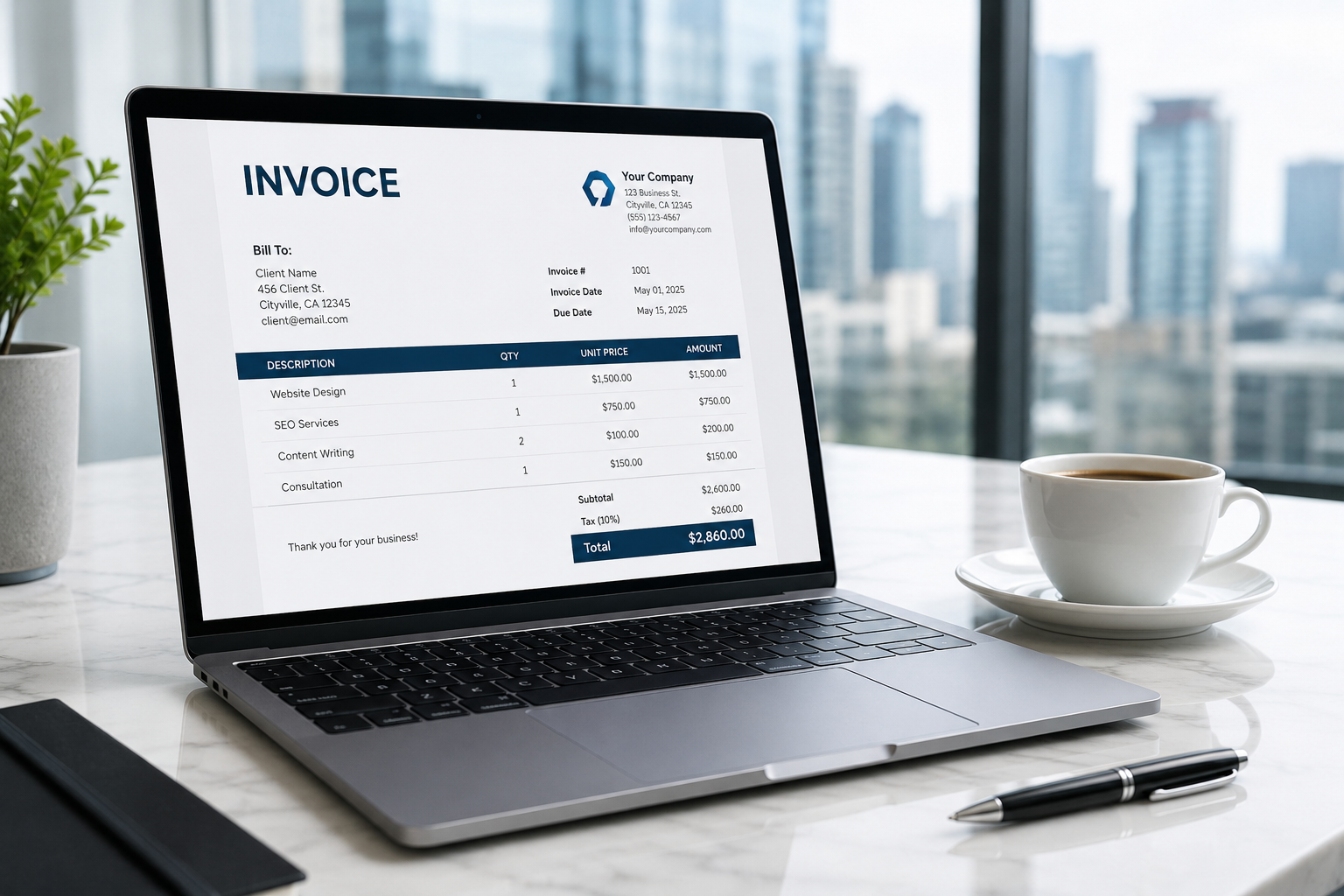
- Use a simple, readable layout. Logo top-left, invoice details top-right, itemized table in the middle, totals and payment info at the bottom.
- Label everything clearly. Don’t make someone hunt for the due date or total amount.
- Keep the total amount prominent. Bold it, or use a slightly larger font.
- Match the language to your client where possible. A bilingual invoice (English plus the client’s language) is a nice touch for non-English-speaking markets, though not required.
- Export as PDF. Never send an editable Word or Excel file as a final invoice PDFs look more professional and can’t be accidentally altered.
Common Mistakes That Delay International Payments
- Forgetting the SWIFT/BIC code on wire transfer details, which bounces the payment back
- Using ambiguous currency symbols instead of ISO codes
- Skipping the due date and relying on vague terms like “due upon receipt”
- Not stating VAT status, leaving the client’s finance team to guess (and often delay payment while they figure it out)
- Inconsistent invoice numbering, which can flag audits or make bookkeeping a nightmare
- Sending invoices in a format the client’s accounting software can’t easily process some companies require specific formats or portals for supplier invoices
Should You Use an Invoice Template or Software?
For one-off international clients, a well-built template (Google Docs, Word, or a free invoice generator) works fine.
If you’re regularly billing across borders, invoicing software pays for itself quickly. Tools like Wave, Bonsai, FreshBooks, or Xero handle:
- Automatic currency conversion
- Multi-language invoicing
- Recurring invoice scheduling
- Payment tracking and reminders
- Tax calculation based on client location
The time saved on manual formatting and chasing payments usually outweighs the subscription cost once you’re sending more than a few invoices a month.
A Quick Pre-Send Checklist
Before hitting send, run through this:
- Business and client details are complete and accurate
- Invoice number follows your sequential system
- Currency is stated using ISO code
- Payment terms, due date, and accepted methods are explicit
- Banking details include SWIFT/BIC and IBAN (if applicable)
- Tax status is clearly noted
- Line items are specific, not vague
- File is saved and sent as a PDF
The Bottom Line
International invoicing isn’t complicated once you build the habit of including the right details every time. Get specific about currency, tax status, and payment logistics upfront, and you’ll spend far less time chasing payments or clarifying details after the fact.
Build a solid template once, adjust it for currency and client-specific tax rules as needed, and international billing becomes just another routine part of running your business not a source of stress every time you land a new client abroad.
