

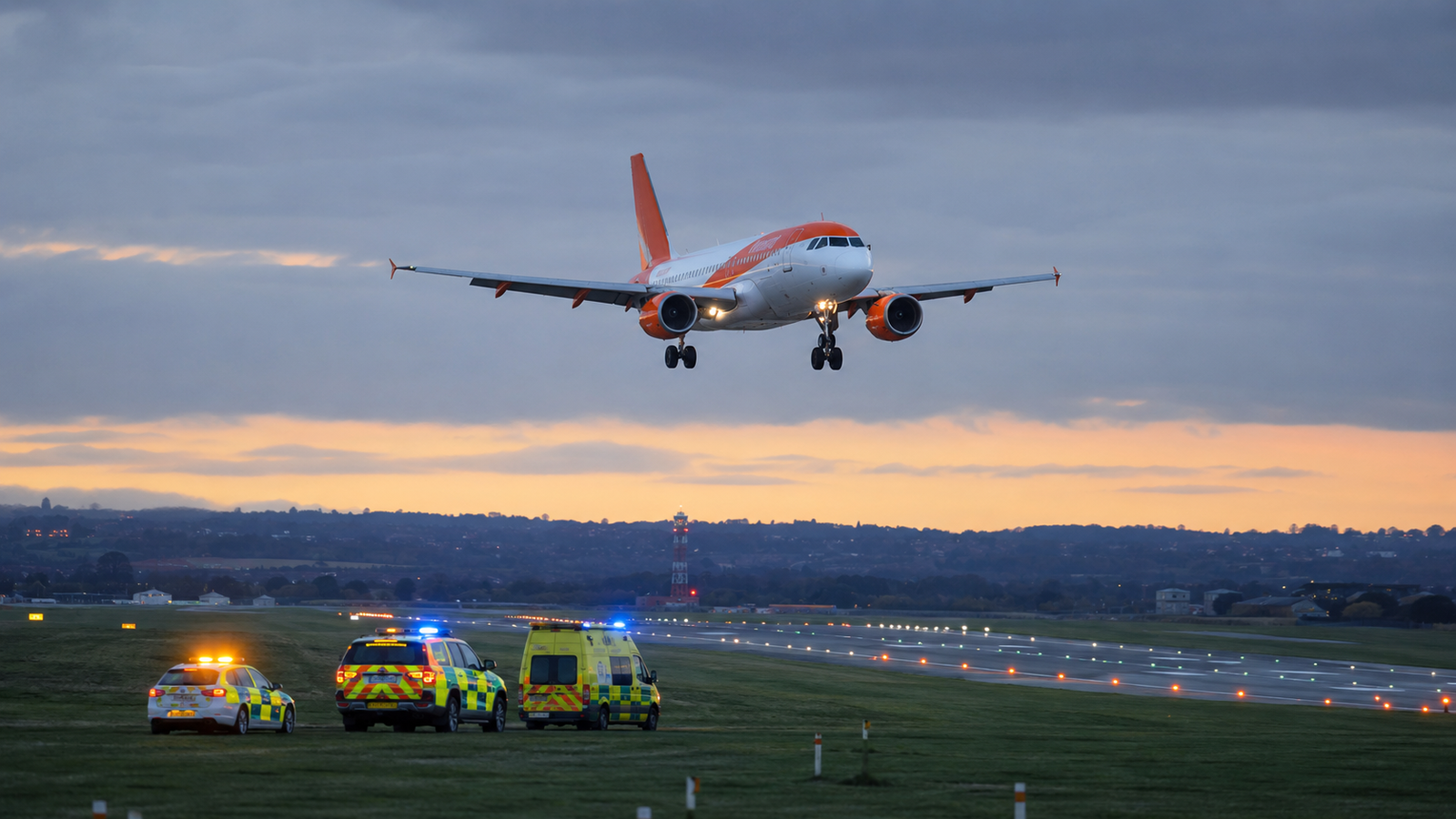
The incident widely searched as the EasyJet Flight U2238 Emergency Landing Newcastle involved an easyJet service travelling from Copenhagen to Manchester on 27 October 2025. The aircraft diverted safely to Newcastle because of a passenger welfare issue described in contemporary reports as a medical emergency. There was no crash, and no confirmed evidence of an aircraft malfunction.
The correct commercial flight number was U2 2238, commonly written without a space as U22238. Its ICAO-style identifier was EZY2238. The shorter number U2238 identifies a separate easyJet flight and should not be used interchangeably with the Copenhagen to Manchester service.
What Happened to the EasyJet Flight?
EasyJet flight U22238 was operating from Copenhagen Airport to Manchester Airport when the crew declared an emergency and diverted to Newcastle International Airport.
Flight-tracking coverage showed the aircraft selecting the emergency transponder code 7700 before changing course for Newcastle. EasyJet attributed the diversion to a passenger welfare issue, while contemporary reporting described it as a medical emergency involving someone on board.
The aircraft landed safely at Newcastle. After the passenger situation had been handled and the aircraft had spent a period on the ground, it departed again and continued to Manchester.
Nothing in the verified reporting indicates that the aircraft crashed, suffered an engine failure or made an uncontrolled landing.
EasyJet Emergency Landing: Key Facts at a Glance
| Detail | Verified information |
|---|---|
| Date | 27 October 2025, continuing into 28 October |
| Scheduled route | Copenhagen to Manchester |
| Correct commercial flight number | U2 2238, normally displayed as U22238 |
| ICAO flight identifier | EZY2238 |
| Aircraft type | Airbus A320-200 |
| Diversion airport | Newcastle International Airport |
| Reported reason | Passenger welfare issue or passenger medical emergency |
| Emergency code | Squawk 7700 |
| Landing outcome | Aircraft landed safely |
| Aircraft fault confirmed? | No |
| Onward journey | The aircraft later continued to Manchester |
| Passenger’s later condition | Not publicly confirmed |
Was the Flight U2238, U22238 or EZY2238?
This is the most important correction to make when discussing the incident.
The easyJet airline designator used on passenger-facing flight numbers is U2. When the airline code and flight number 2238 are written together without a space, they produce U22238:
U2 + 2238 = U22238
Therefore, U22238 was the correct public or commercial flight number for the Copenhagen to Manchester service.
EZY is easyJet’s three-letter ICAO airline designator. Flight-tracking systems, airport systems and aviation websites may consequently show the same service as EZY2238. This is the operational ICAO-style flight identifier associated with U2 2238.
EZY2238 should not automatically be treated as proof of the exact words spoken by the pilots over the radio. Airlines and air traffic control can use modified spoken callsigns in some circumstances to reduce callsign confusion. The available public evidence establishes the tracked ICAO identifier, not a recording of the crew’s voice communications.
The expression U2238 creates a different problem. Parsed correctly, it means:
U2 + 238 = U2 238
That shorter flight number has been used for an easyJet Newcastle to Bristol service and is tracked as EZY238, not EZY2238. Removing one of the repeated number twos therefore changes the flight number completely.
In short:
- U22238 and EZY2238 identify the Copenhagen to Manchester service.
- U2238 and EZY238 identify a different flight number.
- Headlines using “U2238” for the emergency diversion have dropped a digit.
The phrase EasyJet Flight U2238 Emergency Landing Newcastle remains common in searches, but it is not the technically correct identification of the diverted flight.
Why Did the Flight Divert to Newcastle?
The reported reason was a passenger medical emergency, described by easyJet in its disruption information as a “passenger welfare issue.”
When someone becomes seriously unwell during a flight, the crew must consider the passenger’s condition, the time remaining to the planned destination, nearby airports, available medical support, weather, runway suitability, fuel and air traffic conditions.
Newcastle was a practical diversion airport because the aircraft was approaching the north-east of England from across the North Sea. Newcastle International Airport could accept an Airbus A320 and provide access to ground and emergency services.
The diversion did not establish that Manchester Airport was unsafe or unavailable. It indicates that the crew considered landing sooner at Newcastle the appropriate response to the situation on board.
What Does Squawk 7700 Mean?
Squawk 7700 is the transponder code used to indicate a general aircraft emergency.
An aircraft’s transponder sends identifying and altitude-related information to air traffic control radar systems. When pilots select 7700, controllers can quickly recognise that the flight requires special attention and may need priority handling.
The code does not reveal the cause of the emergency. It can be selected for situations including:
- A serious passenger medical problem
- Smoke or unusual fumes
- Pressurisation difficulties
- An engine or systems problem
- Another urgent condition requiring priority
In this case, the evidence connects the emergency declaration to a passenger welfare issue. Squawk 7700 alone is not evidence of engine failure, mechanical damage or an imminent crash.
Timeline From Copenhagen to Newcastle
Because some published reports conflict over the departure time and time-zone labelling, the sequence is more reliable than repeating every reported minute.
| Stage | What occurred |
|---|---|
| Evening of 27 October 2025 | U2 2238 departed Copenhagen for Manchester later than scheduled |
| During the flight | A passenger welfare problem developed on board |
| Approaching the UK | The crew selected Squawk 7700 and turned towards Newcastle |
| Before 11 p.m. UK time | The Airbus A320 landed safely at Newcastle |
| Ground stop | The passenger situation was addressed and the aircraft was prepared for departure |
| Shortly after midnight | The aircraft departed Newcastle for Manchester |
| Early 28 October | The remaining flight continued to its intended destination |
This timeline avoids combining incompatible local and UTC times reported by different articles.
Was There a Technical Problem With the Aircraft?
No technical fault was publicly confirmed.
The easyJet Newcastle emergency landing was linked to a passenger welfare issue, not a problem with the engines, flight controls or other aircraft systems. The aircraft’s ability to depart Newcastle and continue to Manchester also supports the conclusion that the diversion was not reported as a mechanical breakdown.
That does not mean every technical detail of the flight is publicly available. It means there is no reliable evidence supporting claims of an aircraft fault.
A medical diversion can still receive emergency priority. Pilots do not need to wait for the aircraft itself to become unsafe before declaring an emergency.
What Happened After the Newcastle Landing?
After landing, the aircraft remained at Newcastle while the passenger emergency was handled. Contemporary reporting said that the aircraft would be refuelled before continuing to Manchester.
Flight data later showed the A320 departing Newcastle shortly after midnight on 28 October. It then completed the remaining sector to Manchester.
The ground stop allowed the person requiring assistance to be attended to without forcing the rest of the flight to continue while the medical situation remained unresolved.
What Happened to the Passenger?
Public reporting confirms only that the diversion involved a passenger welfare or medical issue.
No reliable public statement identified the passenger, disclosed a diagnosis or provided a confirmed long-term medical outcome. It is also not appropriate to infer the person’s condition from the emergency code or the presence of airport responders.
Claims that the passenger died, suffered a specific illness or was admitted to a particular hospital should therefore be treated as unverified unless supported by a later official statement.
Did the Flight Continue to Manchester?
Yes. Flight-tracking reports indicate that the aircraft left Newcastle at approximately 12:02 a.m. on 28 October and continued to Manchester.
This answers another common misunderstanding about the EasyJet Flight U2238 Emergency Landing Newcastle story. The diversion did not end with the aircraft being grounded indefinitely at Newcastle. After the necessary response and ground stop, the remaining journey was completed.
The continuation also distinguishes the event from a crash or a reported aircraft failure that required the aircraft to be withdrawn from service immediately.
Could Passengers Claim Compensation?
A diversion does not automatically create a right to fixed cash compensation.
Under applicable UK passenger-rights rules, compensation for a delayed arrival generally depends on the length of the delay and its cause. A passenger medical emergency is likely to be considered an extraordinary circumstance outside the airline’s control. If so, fixed delay compensation would normally not be payable, provided the airline took all reasonable measures.
Care and assistance are separate from compensation. Depending on the length and circumstances of the disruption, passengers may still have rights relating to reasonable food, refreshments, communication, accommodation or transport. The relevant thresholds and assistance depend on the journey and delay.
Passengers who paid reasonable expenses because the airline did not provide required assistance should retain itemised receipts and submit them directly to easyJet. Each claim is assessed individually, so travellers should not assume either guaranteed payment or automatic rejection.
Common Misunderstandings About the Incident
“The aircraft crashed at Newcastle”
It did not. The A320 made a safe, controlled diversion and later departed for Manchester.
“An engine failure caused the diversion”
No engine failure or other mechanical fault was confirmed. The reported cause was a passenger welfare emergency.
“U2238 definitely operated from Copenhagen to Manchester”
It did not. The Copenhagen to Manchester flight was U2 2238, written as U22238. U2 238, written as U2238, is a separate flight number associated with Newcastle to Bristol.
“Squawk 7700 proves the aircraft was malfunctioning”
It does not. Code 7700 signals a general emergency and can be used for an urgent medical situation.
“The aircraft never completed the journey”
Flight evidence indicates that it departed Newcastle after midnight and continued to Manchester.
Conclusion
The incident commonly searched as EasyJet Flight U2238 Emergency Landing Newcastle was a safe medical diversion involving easyJet flight U2 2238 from Copenhagen to Manchester on 27 October 2025.
The crew selected Squawk 7700 and landed at Newcastle because of a passenger welfare emergency, not a confirmed aircraft fault. There was no crash, and the Airbus later continued to Manchester.
The accurate identifiers are U22238 for the commercial flight number and EZY2238 for its ICAO flight identifier. U2238 is a separate number associated with a different easyJet route, even though several online headlines have mistakenly used it for this incident.
Frequently Asked Questions
Why did the easyJet flight land in Newcastle?
The Copenhagen to Manchester flight diverted because of a passenger welfare issue reported as a medical emergency. Newcastle was a suitable nearby airport where the aircraft could land and the passenger could receive assistance.
Was there a mechanical fault?
No aircraft fault was publicly confirmed. The available airline information and contemporary reports identify a passenger medical issue as the reason for the diversion.
What does Squawk 7700 mean?
Squawk 7700 is the transponder code for a general emergency. It alerts air traffic controllers that an aircraft needs special attention or priority, but it does not identify the particular type of emergency.
Was anyone injured during the landing?
There is no verified report of anyone being injured because of the landing. A passenger required medical attention before the diversion, but the person’s diagnosis and later condition were not publicly disclosed.
Did the flight continue to Manchester?
Yes. After a ground stop at Newcastle, the aircraft departed shortly after midnight and continued to Manchester.
What is the correct flight number, U2238 or U22238?
For this incident, the correct commercial number was U2 2238, displayed as U22238. EZY2238 was its ICAO flight identifier. U2238 means U2 238 and refers to a different easyJet flight number.
