

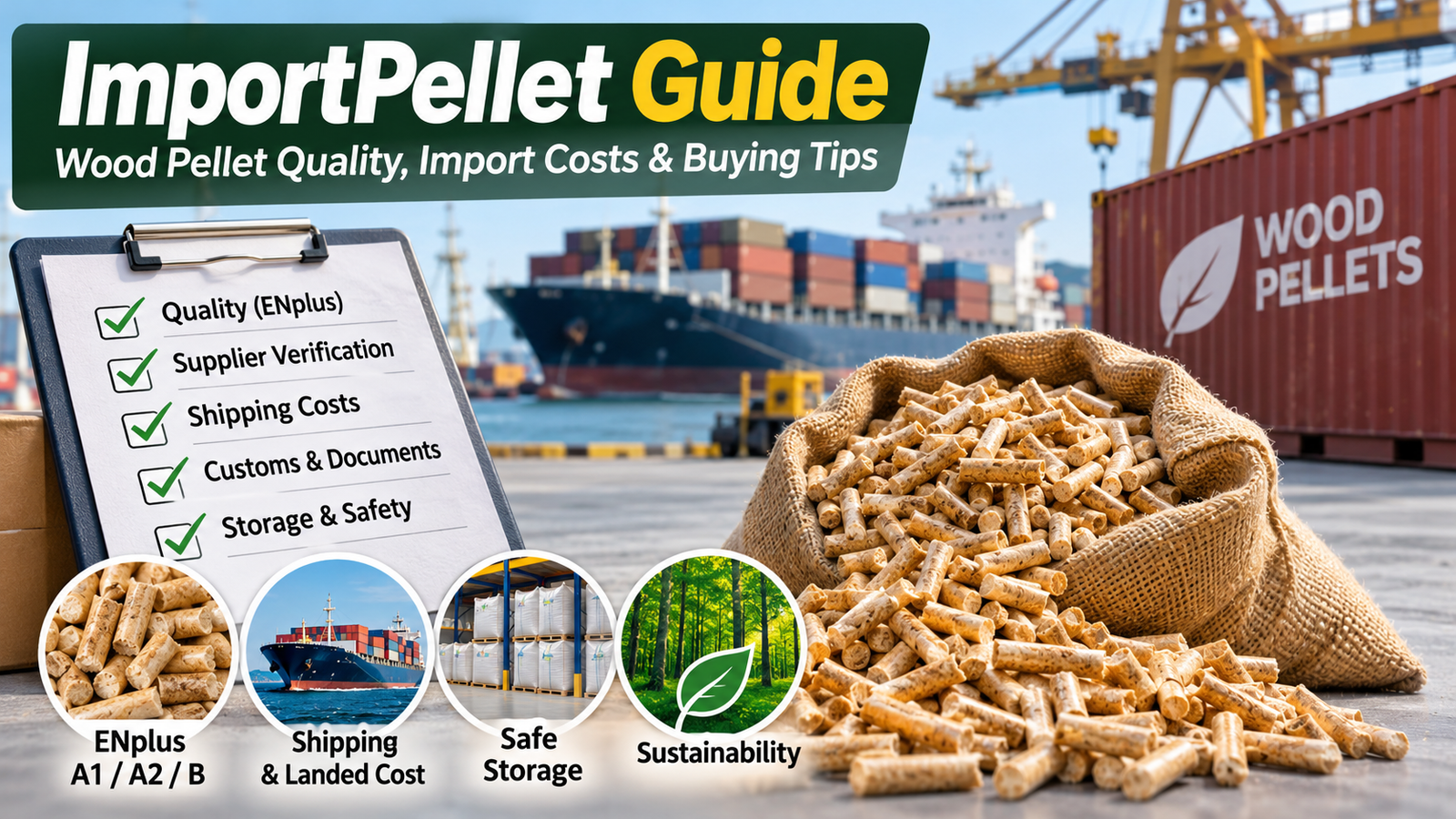
Importing wood pellets can help businesses secure reliable biomass fuel supplies, but finding a low-priced supplier is only one part of the process. Product quality, shipping expenses, customs clearance, and storage conditions all affect the final cost.
ImportPellet is a term associated with international pellet sourcing and importing, particularly wood pellets used for residential heating, commercial boilers, and industrial energy production.
For buyers in the United States and United Kingdom, understanding pellet grades, certification requirements, supplier reliability, and landed costs is essential. This guide explains how wood pellet importing works, what quality standards matter, and how to avoid expensive purchasing mistakes.
What Is ImportPellet?
ImportPellet generally refers to purchasing pellets from suppliers in another country and transporting them to a domestic market. In the biomass industry, the term is commonly associated with wood pellet imports for heating, distribution, and energy production.
ImportPellet is not an internationally recognized fuel certification or quality grade. The name alone also does not establish the existence of a particular company or trading platform.
Wood pellets are compressed cylindrical pieces of processed wood material, commonly manufactured from sawdust, wood shavings, and other suitable woody feedstocks.
Their compact shape, consistent dimensions, and energy density make them practical for automated biomass heating systems.
Why Do Businesses Import Wood Pellets?
Businesses import wood pellets to access additional suppliers, manage fuel availability, and obtain products that meet their technical requirements.
International sourcing can be particularly useful when domestic production is insufficient, or imported pellets offer competitive delivered costs.
Residential Heating Demand
Wood pellets are widely used in residential pellet stoves and boilers.
Household consumers generally prefer pellets that burn consistently, produce limited ash, and require minimal maintenance.
Distributors may import certified pellets in sealed bags for retail customers.
Commercial Heating Applications
Commercial buildings, hotels, greenhouses, and agricultural facilities may use biomass boilers to generate heat.
These operations often require predictable fuel supplies and consistent quality to maintain equipment performance.
Industrial Biomass Energy
Some industrial facilities and power-generation operations use wood pellets as biomass fuel.
Large buyers may purchase substantial quantities through international supply agreements.
Industrial pellet specifications can differ from those required for residential appliances.
Price and Supply Availability
Imported pellets may provide access to competitive prices, especially when overseas producers have sufficient manufacturing capacity.
However, ocean freight, customs expenses, currency movements, and transportation costs must be included before deciding whether importing is economical.
Understanding Wood Pellet Grades and Quality
Wood pellet quality directly influences heating performance, equipment maintenance, storage stability, and purchasing value.
Two shipments may look similar while having significantly different moisture levels, ash content, and mechanical durability.
ENplus A1, A2, and B Compared
ENplus is an internationally used certification scheme for wood pellet quality and relevant production and trading activities.
The scheme’s ST 1001 and ST 1003 second editions became effective on January 1, 2026.
Three recognized quality classes are A1, A2, and B.
| Quality Factor | ENplus A1 | ENplus A2 | ENplus B |
|---|---|---|---|
| Typical application | Residential heating | Compatible residential and commercial boilers | Compatible commercial and larger heating systems |
| Maximum moisture | 10% | 10% | 10% |
| Maximum ash, dry basis | 0.7% | 1.2% | 2.0% |
| Minimum mechanical durability | 98.0% | 97.5% | 97.5% |
| Minimum net calorific value | 4.6 kWh/kg | 4.6 kWh/kg | 4.6 kWh/kg |
These are selected quality requirements. Complete product compliance also involves other technical characteristics and applicable testing procedures.
ENplus A1 generally offers the strictest ash requirements and is commonly selected for residential pellet stoves and boilers.
ENplus A2 permits a higher ash content and may be appropriate for compatible heating equipment.
ENplus B allows broader fuel characteristics and may be used in suitable commercial applications.
The correct pellet grade ultimately depends on the heating equipment manufacturer’s specifications.
Moisture Content
Moisture reduces the useful energy available from wood pellets and can damage their physical structure.
Pellets exposed to water may swell, break apart, and become unsuitable for automated fuel systems.
ENplus quality classes specify a maximum moisture content of 10%.
Ash Content
Ash is the inorganic residue remaining after combustion.
Higher ash levels can increase cleaning requirements and may contribute to operational problems in unsuitable heating equipment.
Low-ash pellets are particularly desirable for household appliances.
Mechanical Durability
Mechanical durability describes how well pellets resist breaking during handling and transportation.
Durable pellets maintain their shape and produce fewer fines.
Excessive fines can create dust, complicate fuel handling, and interfere with certain automated feeding systems.
Heating Value
Heating value describes the amount of energy available from a fuel.
Buyers should distinguish between gross and net calorific values and check whether measurements are reported on a dry or as-received basis.
When comparing suppliers, use laboratory results measured under equivalent conditions.
How to Import Wood Pellets: A Practical Buying Process
Importing wood pellets requires coordinated decisions about specifications, supplier selection, quality inspection, commercial terms, and logistics.
A structured purchasing process reduces the likelihood of receiving unsuitable or damaged fuel.
Identify the Right Product
Start by defining the intended use of the pellets.
A household fuel distributor may require ENplus A1 pellets packed in retail bags, while a larger commercial buyer may need bulk deliveries.
Important specifications include pellet diameter, quality class, moisture content, ash content, durability, packaging, and quantity.
Confirm that the selected product meets the requirements of the equipment or end customers.
Find and Verify Suppliers
Look for manufacturers and established traders capable of supplying the required pellet grade and volume.
Before placing an order, request the supplier’s registered business name, manufacturing location, product specifications, and relevant trading documents.
Check company registration information independently.
Also confirm whether the business manufactures the pellets or purchases them from another producer.
Verify Certifications and Test Reports
If a supplier claims ENplus certification, verify its status through the official certification scheme.
Request the relevant certification identification and confirm that it covers the applicable activities.
Ask for product test reports showing moisture, ash, durability, heating value, and other agreed characteristics.
For substantial orders, independent laboratory testing can provide additional assurance.
Request Samples
Samples allow buyers to evaluate pellet appearance, dimensions, durability, and basic quality characteristics.
However, a small sample does not guarantee that the entire commercial shipment will meet the same standards.
Representative sampling and independent inspection are especially useful for larger purchases.
Agree on Contract Terms
A written purchasing agreement should clearly define the product, quantity, quality requirements, delivery schedule, and payment conditions.
Include the agreed Incoterm, named delivery location, inspection arrangements, and procedures for dealing with defective material.
Buyers should understand when ownership and transportation risks transfer under the contract.
Inspect the Shipment
Where appropriate, arrange inspection before loading and after delivery.
Check packaging condition, moisture damage, cargo weight, and conformity with the agreed specification.
Document any discrepancies promptly to support potential insurance or contractual claims.
What Does ImportPellet Shipping Really Cost?
The total cost of importing wood pellets includes much more than the manufacturer’s selling price.
International freight, insurance, port handling, customs clearance, inland delivery, and storage can substantially affect the final expense.
Main Import Cost Components
Product price: The amount charged by the manufacturer or supplier.
Ocean freight: The expense of transporting the shipment between ports.
Cargo insurance: Protection against covered losses during transportation.
Port charges: Terminal handling, documentation, and other port-related expenses.
Customs expenses: Brokerage fees, applicable import duties, and taxes.
Inland transportation: Moving pellets from the arrival port to the final destination.
Storage and handling: Warehousing, unloading, and inventory management.
Example of Wood Pellet Import Costs
The following example is hypothetical and demonstrates how an importer can calculate landed costs. It does not represent current market prices.
Assume a business imports 100 metric tonnes of wood pellets.
| Expense | Estimated Cost |
|---|---|
| Wood pellet purchase | $18,000 |
| Ocean freight | $4,200 |
| Cargo insurance | $300 |
| Port handling and documentation | $1,600 |
| Customs brokerage | $400 |
| Inland transportation | $1,800 |
| Storage and handling | $700 |
| Financing and contingency | $500 |
| Total landed cost | $27,500 |
The calculation assumes the purchase price excludes separately listed shipping expenses. Import duties and destination taxes are not included.
The landed cost per purchased tonne is:
$27,500 ÷ 100 = $275 per tonne
However, buyers should also account for any unusable material.
Calculate the Cost per Usable Tonne
Suppose 4% of the shipment becomes unusable because of moisture damage, handling losses, or excessive fines.
The original shipment contains 100 tonnes.
After a 4% loss:
100 − 4 = 96 usable tonnes
The adjusted cost becomes:
$27,500 ÷ 96 = $286.46 per usable tonne
This calculation demonstrates why a low purchase price does not necessarily guarantee a lower final fuel cost.
Importers should compare offers using the total delivered cost of usable pellets.
Shipping, Customs, and Storage Safety
International pellet transportation requires suitable shipping arrangements, accurate documentation, and safe cargo handling.
Wood pellets must remain protected from water and should be stored under appropriate conditions throughout the supply chain.
Choosing the Right Incoterms
Incoterms define important transportation responsibilities between buyers and sellers.
Common arrangements include:
| Incoterm | Meaning |
|---|---|
| FCA | Free Carrier |
| FOB | Free on Board |
| CIF | Cost, Insurance and Freight |
| DAP | Delivered at Place |
FCA is commonly suitable for containerized shipments, while FOB and CIF apply to appropriate sea transport arrangements.
Under CIF, the seller arranges freight and specified insurance, but transportation risk transfers when the goods are loaded on board the vessel.
Under DAP, the seller is responsible for delivering goods to the named destination, but import clearance and unloading generally remain the buyer’s responsibility.
Always specify the named location and the applicable Incoterms edition in the contract.
Required Import Documents
Depending on the destination and shipment, importers may need:
- Commercial invoice
- Packing list
- Bill of lading or other transport document
- Customs declaration
- Certificate of origin, where required
- Product specifications and laboratory reports
- Applicable permits or additional regulatory documentation
Wood pellets generally fall under Harmonized System subheading 4401.31, but importers must verify the complete classification used in the destination country.
US buyers should check applicable requirements with customs authorities and other relevant government agencies.
UK buyers should verify current commodity classifications, customs procedures, and any relevant environmental or plant-health controls.
Protecting Pellets From Moisture
Moisture exposure can cause pellets to swell and deteriorate.
Inspect containers and cargo areas before loading. Avoid exposing pellets to rain during handling and unloading.
Use suitable packaging and dry storage facilities.
Damaged bags or wet material should be assessed before being introduced into heating systems.
Carbon Monoxide and Storage Hazards
Wood pellets can release carbon monoxide and reduce oxygen levels in enclosed storage spaces.
These hazards may occur even without visible combustion.
Pellet silos, cargo holds, and poorly ventilated storage areas can therefore present serious risks.
Never enter an enclosed pellet storage area without an appropriate confined-space safety procedure.
Professional precautions may include atmospheric testing, ventilation, trained personnel, and emergency rescue arrangements.
Wood pellet dust can also create respiratory and combustible-dust hazards.
Storage and handling procedures should account for these risks.
Are Imported Wood Pellets Sustainable?
Wood pellets are considered a form of biomass fuel, but their environmental impact depends on the complete supply chain.
Imported pellets should not automatically be described as carbon-neutral or environmentally sustainable.
Responsible Raw Material Sourcing
Some wood pellets are produced from sawdust, wood shavings, and other residues generated during timber processing.
Using suitable processing residues can make productive use of available woody material.
However, sustainability also depends on forestry practices, harvesting methods, land management, and biodiversity protection.
Buyers should request credible information about feedstock origin and sourcing practices.
Manufacturing and Transportation Emissions
Pellet manufacturing requires energy for drying, processing, and compression.
The energy sources used during production influence the overall environmental footprint.
Transportation also contributes emissions through trucks, vessels, and handling equipment.
A reliable sustainability assessment should consider production, transportation, and final fuel use.
Understanding Certification Limitations
ENplus certification primarily addresses pellet quality and relevant supply-chain requirements.
It does not, by itself, establish that a shipment meets every environmental sustainability criterion.
Additional sourcing documentation, applicable sustainability certifications, and lifecycle assessments may be necessary.
Businesses should avoid unsupported environmental claims and confirm the requirements relevant to their market.
Five Mistakes to Avoid Before Ordering
Several purchasing mistakes can turn an apparently attractive international quotation into an expensive problem.
1. Failing to Verify the Supplier
Unverified suppliers can create payment, quality, and delivery risks.
Confirm the business identity, operational details, certification claims, and payment instructions before transferring funds.
2. Ignoring Technical Specifications
Ordering pellets without clear fuel requirements can result in equipment compatibility problems.
Specify the relevant grade, dimensions, moisture level, ash content, and durability requirements.
3. Comparing Only Purchase Prices
A low factory price may become uncompetitive after freight and handling expenses.
Calculate the complete landed cost, including expected losses and applicable taxes.
4. Accepting Unclear Contract Terms
Poorly defined delivery responsibilities and quality conditions can create disputes.
Agree on payment conditions, inspection procedures, delivery terms, and remedies before shipping.
5. Overlooking Transportation and Storage Risks
Water exposure, cargo damage, dust, and unsafe storage conditions can reduce product value and create safety hazards.
Arrange suitable packaging, cargo inspections, insurance, and safe handling facilities.
Frequently Asked Questions
What Does ImportPellet Mean?
ImportPellet refers to international pellet sourcing and importing, particularly wood pellets used for biomass heating and energy production. The process involves selecting suppliers, verifying product quality, arranging transportation, completing customs procedures, and receiving the shipment.
Is ImportPellet a Company or Trading Platform?
ImportPellet is not inherently the name of a verified company or trading platform. The term may be used descriptively in connection with pellet importing. Any business operating under that name should be independently verified before purchasing.
Which Wood Pellet Grade Is Best for Home Heating?
ENplus A1 is commonly preferred for residential pellet stoves and boilers because of its strict ash requirements and consistent fuel characteristics. Buyers should confirm the fuel specifications recommended by their appliance manufacturer.
How Much Does Importing Wood Pellets Cost?
The cost depends on product quality, order quantity, supplier location, shipping method, freight rates, customs charges, and inland delivery. A complete landed-cost calculation is necessary to compare international suppliers accurately.
What Documents Do Wood Pellet Importers Need?
Common documents include a commercial invoice, packing list, transport document, customs declaration, and applicable product documentation. Additional requirements vary by destination, origin, and shipment characteristics.
Importers should also verify supplier credentials, arrange appropriate inspections, protect pellets from moisture, and follow relevant storage safety procedures.
Final Thoughts
ImportPellet involves more than purchasing wood pellets from an international supplier. Successful importing requires careful product selection, reliable quality verification, clear shipping agreements, and accurate cost planning.
Buyers should prioritize verified suppliers, suitable pellet grades, complete landed-cost calculations, and safe delivery arrangements.
Comparing the cost of usable, specification-compliant pellets rather than purchase prices alone helps businesses make better purchasing decisions and develop more reliable biomass fuel supply chains.
