

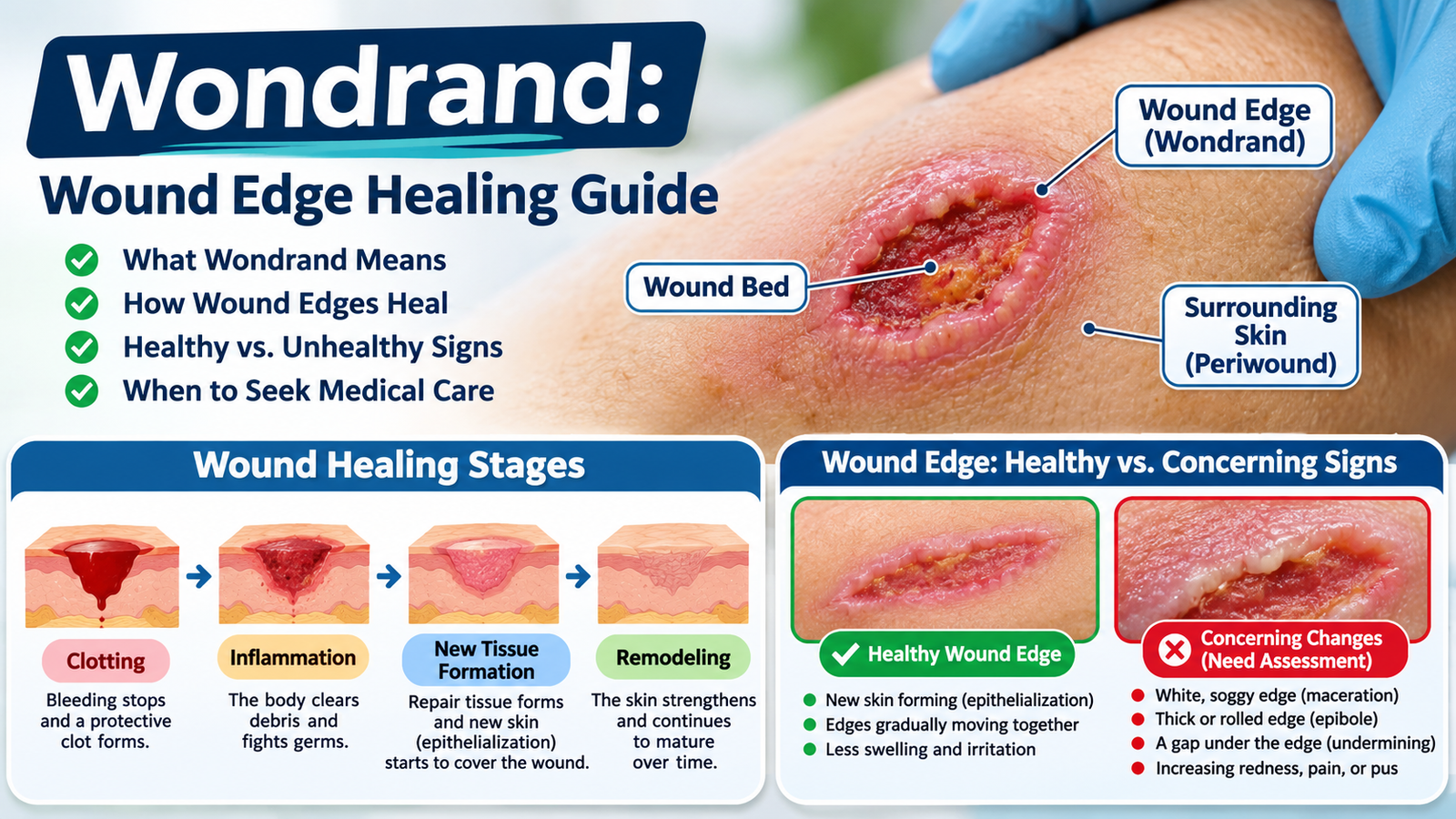
When a cut starts closing, it is tempting to judge healing by the scab alone. The skin at the border matters just as much. Wondrand is the Dutch word for wound edge, the place where injured tissue meets the surrounding skin. Changes along this margin can help healthcare professionals assess healing, but they cannot confirm infection by appearance alone. Here is what a wound edge does, which changes may deserve attention, and how to care for minor injuries without disturbing fragile new skin.
What Does Wondrand Mean?
In Dutch, wond means “wound” and rand means “edge” or “border.” Wondrand translates to wound edge or wound margin. The plural is wondranden. The comparable German word is Wundrand, spelled with a u.
Wondrand is not a disease, medication, or treatment. It describes an anatomical feature that is assessed during wound care. In Dutch clinical records, the term can be associated with findings such as new skin formation, irritated skin, excess moisture, or undermining beneath the margin.
Why Is the Wound Edge Important for Healing?
For many open wounds, the edge is where fresh surface skin begins to spread across the opening. Healthcare professionals call this process epithelialization. If the wound is progressing, its open area may gradually shrink while new tissue fills in underneath.
A complete assessment considers three connected areas:
- Wound edge: The border of the opening, checked for new skin, thickening, rolling, gaps, or other changes.
- Wound bed: The exposed tissue within the wound, where repair tissue may develop.
- Surrounding (periwound) skin: The nearby skin, which may be affected by moisture, friction, adhesive dressings, or inflammation.
The edge is important, but it is only one part of the picture. A clinician also considers wound size, depth, drainage, circulation, pain, and whether the wound is improving over time. A closed incision heals differently from an open ulcer.
How Does a Wondrand Change During Healing?
Wound healing happens through overlapping stages, not on an identical schedule for everyone. Small cuts often improve relatively quickly; deeper wounds and wounds affected by circulation problems can take much longer.
1. Clotting (hemostasis). After many injuries, blood forms a clot to help stop bleeding. A scab may protect the surface, although some types of wounds do not develop one.
2. Inflammation. The immune system clears damaged material and begins repair. Mild local swelling, tenderness, and warmth can occur early. Symptoms that intensify or spread are more concerning than those that gradually settle.
3. New tissue formation. The wound may develop granulation tissue, which helps fill the damaged area. New surface skin then moves across the wound during epithelialization. At first, this new skin may appear delicate, smooth, or shiny.
4. Remodeling. After closure, collagen reorganizes and the repaired area becomes stronger. This process can continue for months. Scar tissue may remain less flexible and less strong than uninjured skin.
Healing differs by skin tone, wound depth, and overall health. Color alone cannot show the stage.
Healthy vs. Unhealthy Wondrand: What to Look For
Wound edge assessment looks for a pattern of progress, rather than treating one change as proof of good or bad healing. Some observations are reassuring; others need professional interpretation.
| Wound-edge finding | What it may suggest | What to do |
|---|---|---|
| Thin new skin advancing inward | Epithelialization may be occurring | Protect the fragile surface and follow dressing instructions. |
| Opening gradually becoming smaller | The wound may be progressing toward closure | Look for improvement over time. |
| White, soft, waterlogged-looking skin | Maceration from prolonged moisture | Ask for advice if the dressing leaks or the change persists. |
| Thickened or curled-over margin | A rolled edge (epibole) that may interfere with closure | Have a wound-care clinician assess it. |
| A pocket extending beneath the skin edge | Possible undermining | Do not probe or try to clean underneath it yourself. |
| Increasing pain, spreading discoloration, warmth, or pus | Possible infection or other complication | Seek prompt medical assessment. |
Pink or pale skin can reflect healing or other changes. Redness may be harder to see on darker skin. No single visual feature can confirm or rule out infection.
Common Problems That Delay Wound Edge Healing
Moisture Imbalance
A wound needs a suitable moisture balance. Too much fluid can soften and damage the surrounding skin, causing maceration. Too little moisture may also interfere with the movement of new surface cells. A dressing that is repeatedly soaked, leaking, or irritating the skin should be reviewed by a healthcare professional.
Repeated Pressure and Friction
Shoes rubbing a heel, repeated movement across a cut, or prolonged pressure can injure the margin just as new skin begins to form. Pressure injuries need more than a fresh bandage: the source of pressure must be addressed through an appropriate care plan.
Infection and Ongoing Inflammation
Infection can interfere with tissue repair and may cause increasing pain, drainage, heat, swelling, or spreading skin changes. Normal early inflammation can look similar in limited ways, so medical decisions should consider the wound’s history and the person’s overall condition, not appearance alone.
Poor Circulation and Underlying Conditions
Repairing skin depends on adequate blood flow. Diabetes, vascular disease, and certain other conditions can slow healing. A new foot wound in a person with diabetes needs prompt medical advice, even without much pain, because reduced sensation can hide serious problems.
How to Care for a Wound Edge Safely
For a minor, uncomplicated cut or scrape, wash your hands first. Apply steady pressure with a clean cloth or dressing if it is bleeding. Once bleeding is controlled, gently rinse the wound with clean running water, clean the skin around it, and cover it with an appropriate sterile dressing or adhesive bandage.
Keep the covering clean and change it when wet or dirty, following the dressing instructions. Avoid picking scabs, repeatedly removing a dressing just to check the edge, or applying unfamiliar products inside the wound. Never cut away thickened tissue or use household tools to investigate an opening beneath the edge.
Surgical incisions require the surgical team’s instructions. A chronic leg ulcer, pressure injury, diabetic foot wound, bite, deep puncture, or heavily contaminated wound may need specialist assessment rather than routine home first aid. Treatment depends on the wound’s cause.
If a wound is not improving as expected, ask a clinician to assess it rather than trying to make it heal faster with unproven remedies.
When Should You Seek Medical Attention?
Arrange prompt medical advice if pain is increasing instead of easing; the wound becomes more swollen or hot; discoloration spreads; pus appears; or you develop a fever or feel unwell. A surgical wound that reopens or a wound that is getting larger also needs assessment. Anyone with diabetes who notices a new foot wound should contact a healthcare professional promptly.
Seek emergency medical care for bleeding that will not stop with firm pressure, a very large or deep wound, loss of movement or sensation, or an embedded object such as glass. Do not remove a deeply embedded object yourself. Bites and dirty puncture wounds need timely medical assessment even when bleeding is limited.
Check tetanus protection. Whether a tetanus vaccine or tetanus immune globulin is needed depends on the wound type and vaccination history. Under CDC guidance, for people who completed their primary vaccine series, a booster may be needed after 10 years for a clean, minor wound or 5 years for a dirty or major wound. An unknown or incomplete vaccination history also requires clinical assessment.
In the UK, NHS 111 can direct non-emergency urgent care, while 999 is for emergencies. In the US, seek urgent care for concerning injuries and call 911 for emergencies.
Wondrand Frequently Asked Questions
Is Wondrand a medical condition?
No. Wondrand is simply the Dutch term for a wound edge. It is not a diagnosis, infection, or method of treatment.
What does a healthy wound edge look like?
New skin may gradually advance inward as the open area becomes smaller. Its color can vary with skin tone and wound type. Healthcare professionals assess the wound’s progress over time rather than relying on appearance alone.
Why is my wound edge white and soft?
A soft, soggy-looking edge can be a sign of maceration from too much moisture. White tissue can have other explanations, so persistent changes, leakage, or discomfort should be assessed.
Does a red wound edge always mean infection?
No. Mild inflammation can be part of early healing. Spreading redness or discoloration, worsening pain, pus, fever, or feeling unwell should prompt medical advice.
How do healthcare professionals assess a wound edge?
They look for advancing new skin, rolled margins, undermining, drainage, and changes in nearby skin. Some clinicians use the TIME framework—Tissue, Infection/Inflammation, Moisture, and Edge—to organize assessment. They also evaluate the wound’s cause and the person’s overall health.
Final Thoughts
Wondrand is the boundary where surface healing often takes place. Protecting that margin, noticing changes over time, and following appropriate wound-care instructions can support recovery. A concerning wound needs a qualified professional—not a color comparison or an online diagnosis.
Medical Sources
- NHS — Cuts and grazes
- MedlinePlus — How wounds heal
- MedlinePlus — Surgical wound care: closed
- CDC — Clinical guidance for tetanus wound management
- Zorginformatiebouwstenen — Wound clinical data standard (including wound edge)
- Northamptonshire Healthcare NHS Foundation Trust — Diabetic foot warning signs
Medical Disclaimer
This article is for general educational purposes and does not provide a diagnosis or replace personalized medical advice. Seek professional assessment for a wound that is worsening, slow to heal, or causing concern. For severe bleeding or another medical emergency, contact your local emergency service immediately.
