

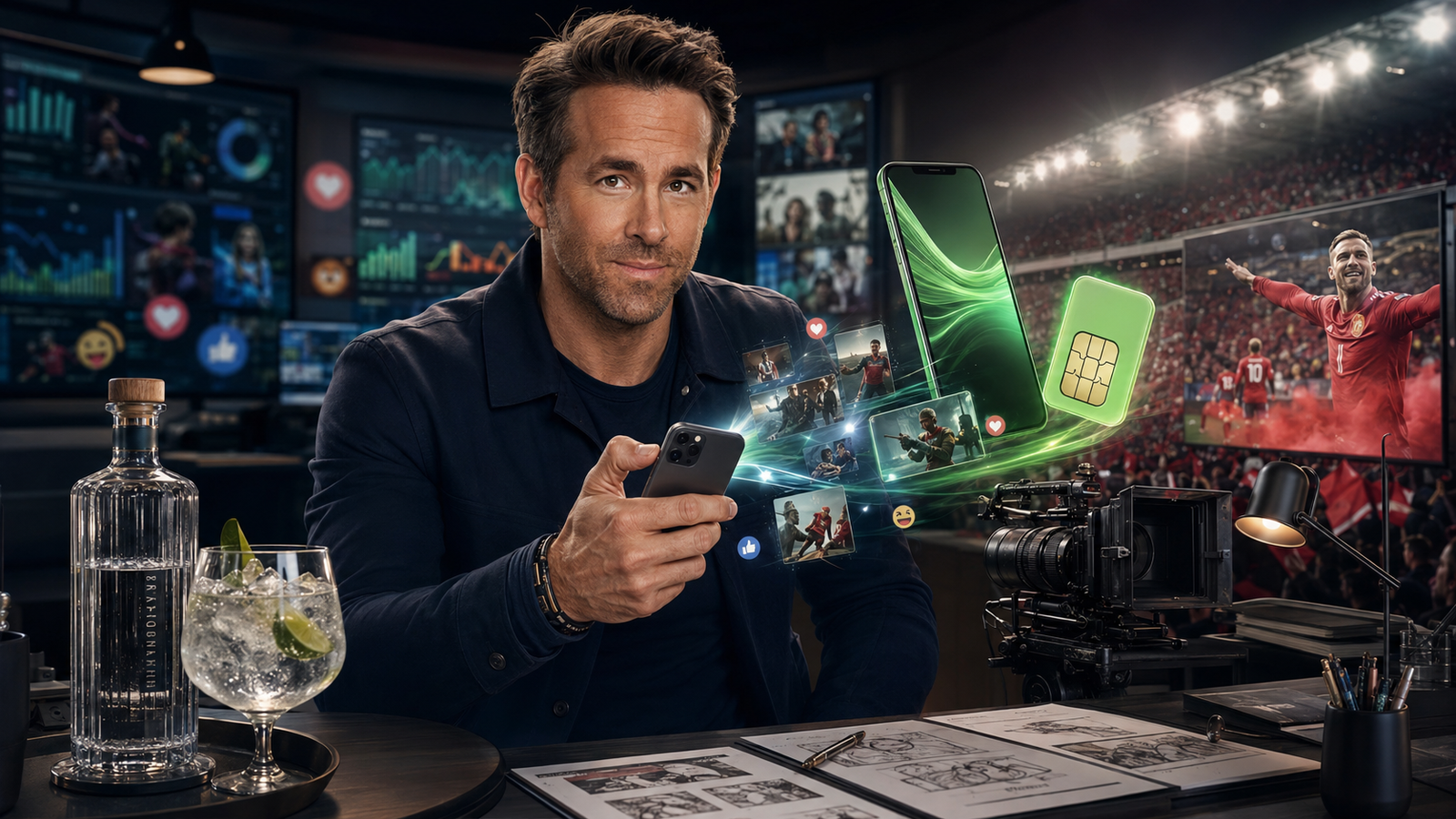
Corporate advertising once meant glossy storyboards, cautious slogans, and a committee debating whether a joke might frighten procurement. Ryan Reynolds operates in another universe: fast, culturally alert, self-mocking, and engineered for the social feed. The actor behind Deadpool has become an elite advertising operator whose ownership stakes, production infrastructure, and audience work as one commercial system. Understanding How Ryan Reynolds Uses Digital Marketing to Build His Brands means looking past celebrity endorsement. He designs brands that behave like entertainment properties, then turns attention into distribution and enterprise value.
The Core Framework: What Is “Fastvertising”?
Maximum Effort, the company Reynolds built with executive and producer George Dewey, calls its signature approach “fastvertising.” The idea is simple, but the execution is not: identify a cultural moment, find the brand’s legitimate role inside it, make the piece immediately, and publish before the internet moves on.
Traditional campaigns may pass through strategy, production, legal review, media planning, and executive approval over several months. Fastvertising compresses that chain into days. Maximum Effort’s portfolio lists the Aviation Gin and “Peloton Girl” response at three days, its Peloton and Mr. Big spot at three days, and a State Farm campaign featuring Donna Kelce at six days. Speed alone is not the strategy. A fast but irrelevant post is clutter. The advantage comes from cultural agility, short approval paths, trusted crews, and a recognizable point of view. The ad does not interrupt the news cycle. It becomes the next episode.
Deep-Dive Case Studies: From Underdog Brands to Billion-Dollar Exits
Aviation Gin: Weaponizing Self-Deprecating Comedy
Premium spirits advertising often sells solemnity: copper stills, slow-motion botanicals, inherited wisdom, and a narrator who sounds personally acquainted with oak. Aviation Gin mocked that vocabulary while still benefiting from it.
In “The Process,” Reynolds narrates an absurdly laborious production ritual. Workers mist oranges with tears, apologize to juniper berries, and beat them up. The film signals quality, then punctures its own prestige. The product remains premium, but the brand refuses to act impressed with itself.
That contradiction became repeatable. Father’s Day “Vasectomy” cocktail videos turned a recipe demonstration into a joke about parenthood. A later Just Friends reunion with Amy Smart exposed awkward takes and artificial product placement inside the ad. Each piece gives viewers a comic premise first and a bottle second.
The result was not a simple $610 million payday for Reynolds. Diageo’s 2020 transaction covered Aviation Gin and other Davos Brands assets, with $335 million upfront and up to $275 million contingent on performance. Still, it demonstrated how a distinctive media voice can increase strategic value. Reynolds retained an ongoing interest in the brand because the personality was part of the acquisition logic.
Mint Mobile: Disrupting Subscriptions via Low-Budget Relatability
Telecom advertising is usually a blizzard of coverage maps, disclaimers, and device offers. Mint Mobile took the opposite route. Reynolds stood in front of a green screen, showed deliberately plain slides, and treated low production value as evidence of financial discipline.
The joke supported the business model. Mint sold wireless service online in multi-month plans, without a large retail footprint. Ads that looked cheap made the $15-per-month starting proposition feel coherent. Gloss would have weakened the argument.
Specific campaigns translated operations into entertainment. During the 2020 Super Bowl, Mint avoided a giant national media buy and offered free service during the game. “Winnie-the-Screwed” used the original Winnie-the-Pooh text entering the U.S. public domain to satirize inflated wireless bills. Other spots used rudimentary presentation decks, making the owner appear frugal and slightly embarrassed by the category.
T-Mobile completed its acquisition of Mint’s parent, Ka’ena Corporation, in May 2024. The announced consideration was up to $1.35 billion, but that included Mint, Ultra Mobile, and Plum, not Mint alone or Reynolds’s personal proceeds. The sharper lesson is T-Mobile’s stated enthusiasm for Mint’s direct-to-consumer marketing formula. The comedy built an acquisition channel, not merely views.
Wrexham AFC: Turning a Sports Investment Into a Global Reality Show
When Reynolds and Rob McElhenney took over Wrexham AFC in 2021, they did not market a fifth-tier Welsh football club as a celebrity accessory. They built a story world around the team, town, supporters, and possibility of failure.
Welcome to Wrexham became the long-form engine. Social clips, match-day posts, player stories, supporter reactions, and the documentary fed one another. Someone arriving for the Hollywood owners could stay for striker Paul Mullin, a local pub, the women’s team, or the anxiety of promotion. The club became an ensemble rather than a logo.
Matches produce unscripted episodes, and defeats deepen the story instead of invalidating the campaign. The series offers international discovery, social media sustains attention, and merchandise converts affection into revenue. The owners supply reach, but local people supply legitimacy. That balance carries the project beyond football fandom.
The Peloton Ad Hijack: A Masterclass in Real-Time Execution
In December 2019, Peloton’s holiday commercial became a cultural punching bag. Reynolds and Maximum Effort recognized that actress Monica Ruiz had become the involuntary face of the controversy.
The Aviation Gin response, “The Gift That Doesn’t Give Back,” placed Ruiz at a bar with two concerned friends. Nobody named Peloton. Her fixed expression, a toast to “new beginnings,” and the social caption, “Exercise bike not included,” completed the joke. It rewarded viewers for already knowing the meme.
The campaign is often described as a 48-hour turnaround. The agency’s own project page lists it as three days, a reminder that speed claims deserve scrutiny. Either way, the team had to reach Ruiz, secure agreement, write, shoot, edit, clear, and distribute while the debate was hot. Aviation bought relevance with timing rather than a vast media budget.
The Core Elements of How Ryan Reynolds Uses Digital Marketing to Build His Brands
Storytelling Over Product Pitching
Reynolds starts with tension: a hated ad, an absurd expense, a celebrity rivalry, or an underdog confronting failure. The product becomes a prop, solution, or punchline. People forward stories, not value propositions, and the joke encodes the reason to buy, such as Mint’s low price or Aviation’s lack of pomposity.
The Power of Flaws and Authenticity
Fame could feel remote, so self-deprecation closes the distance. Reynolds plays the confused owner, stingy advertiser, or executive whose deck barely survived PowerPoint. The craft is controlled: “authentic” means admitting that viewers understand advertising. Visible green screens, awkward integrations, cheap graphics, and budget jokes make them collaborators in the sell.
Leveraging Personal Distribution Networks
Reynolds’s social accounts are an owned launchpad. A campaign can trigger press, reactions, partner amplification, paid cutdowns, and follow-up content. The deeper advantage is audience expectation. People follow him for dry comedy, so a commercial in that voice feels native. Brands borrow not just his reach, but his permission to entertain.
Behind the Scenes: The Team and Operations Fueling the Machine
The lone celebrity genius is a useful myth. Maximum Effort combines Reynolds’s instincts and distribution with Dewey’s leadership, writers, producers, editors, operators, publicists, lawyers, and platform specialists.
Fast work requires pre-agreed boundaries: a clear voice, decision-maker access, trusted talent, modular production, rapid legal review, and authority to kill a weak idea. Alcohol adds responsible-marketing rules, telecom claims need accuracy, and a football club must respect supporters whose identity predates its owners.
Reynolds also works with operators who understand supply, pricing, service, and finance. Marketing cannot repair dropped calls, poor distribution, or a badly run club. The funny front end and serious back end must tell the same story.
Tactical Takeaways for Modern Entrepreneurs and Creators
- Write a comic truth. Make what customers find ridiculous about the category your premise.
- Build a response cell. Assign a decision-maker, writer, editor, producer, and legal contact before a trend appears.
- Set a relevance test. React only when the event connects naturally to product, audience, and voice.
- Use a 24-hour decision window. Approve, revise, or abandon quickly. Late memes look needy.
- Design recurring formats. Direct-to-camera videos, screen recordings, questions, and simple slides can become recognizable series.
- Put the product inside the mechanism. If the joke works after replacing your product with any competitor, the integration is too weak.
- Create one hero asset and many cuts. Plan vertical clips, stills, reaction posts, email copy, and paid variants during production.
- Measure the full funnel. Track watch time, shares, branded search, site visits, conversion rate, customer acquisition cost, retention, and earned-media pickup.
- Keep a risk matrix. Score legal exposure, audience harm, talent risk, brand fit, and whether humor overwhelms the offer.
- Separate speed from sloppiness. Templates, approved claims, usage rights, backup edits, and escalation rules make rapid publishing safer.
Applying How Ryan Reynolds Uses Digital Marketing to Build His Brands to a Lean Team
A startup needs a distinctive voice, repeatable format, small approval loop, and product truth worth dramatizing. Start one weekly direct-to-camera series and reserve 20 percent of the calendar for reactive ideas. Keep approved facts, templates, rights, and calls to action ready. Publish one sharp concept while it matters, then retarget engaged viewers with a clear offer. Borrow the discipline, not Reynolds’s vocal tics.
The Risks of the Celebrity-Led Marketing Model
Celebrity attention can hide dependence. If Reynolds steps back, a brand may lose its voice, reach, and press magnet at once. Repeating the same wink can also flatten into shtick.
Humor creates asymmetric risk. A good joke earns affection; a bad one looks opportunistic. Speed leaves less time to spot rights, factual, regulatory, and interpretation problems. Personal scandals can transfer to every associated company.
Survivorship bias matters too. Aviation and Mint paired memorable ads with real products, operators, and viable economics. Funny posts rarely become billion-dollar transactions. A durable brand needs a voice larger than its spokesperson and an experience worth returning to.
Conclusion
Reynolds has blurred Hollywood and business until the ad, social post, documentary, founder story, and product launch feel like one franchise. This is vertically integrated attention: ownership creates incentive, production creates speed, personality creates distinction, and distribution creates leverage.
The enduring lesson from How Ryan Reynolds Uses Digital Marketing to Build His Brands is not to become louder, funnier, or more famous. It is to build a company capable of noticing what culture is saying, answering in a voice people recognize, and connecting that answer to a product truth. When entertainment and operations support each other, marketing stops behaving like an announcement and starts behaving like a business asset.
