

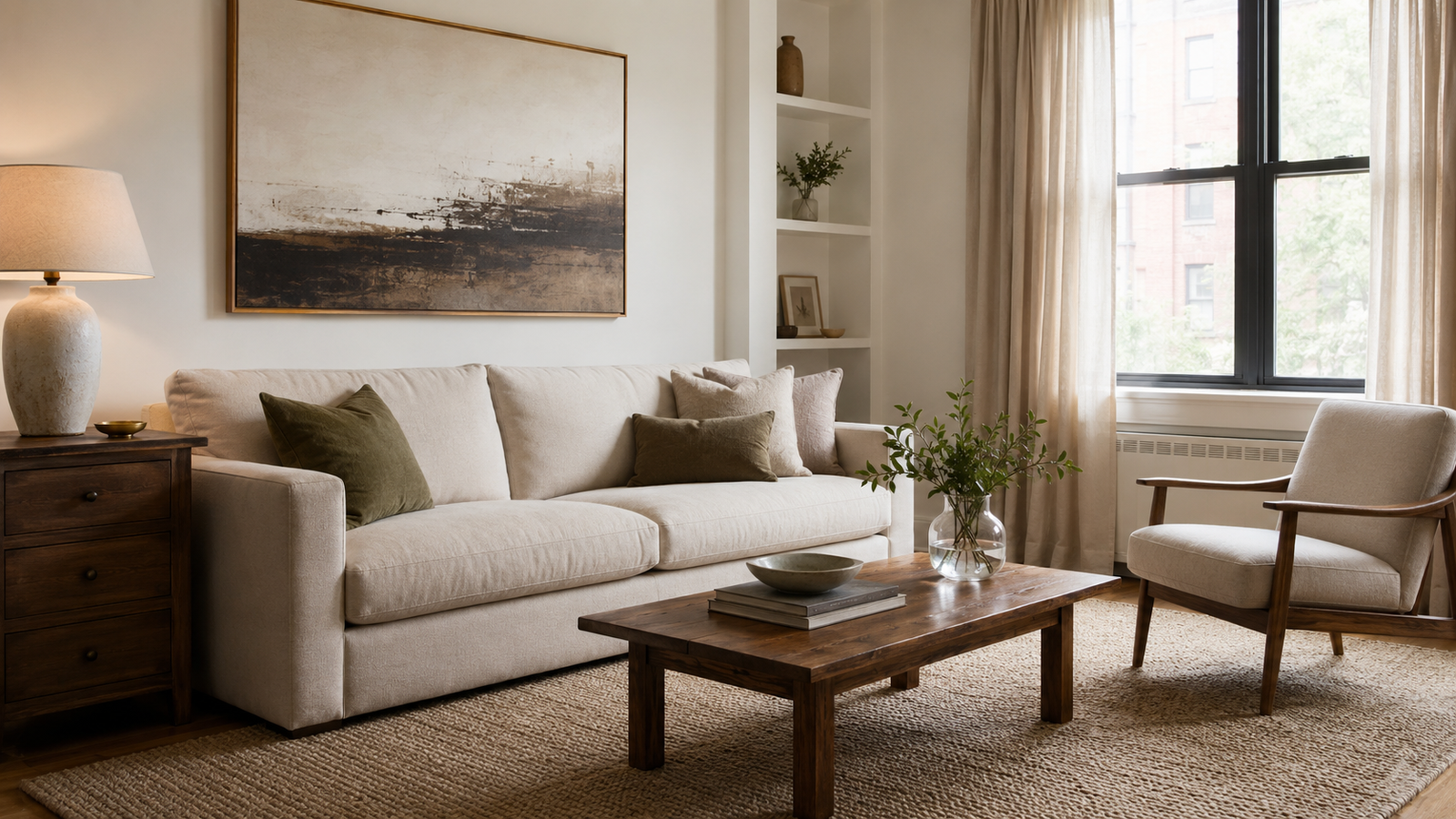
Learning How to Design a Quiet Luxury Interior Without Spending a Fortune starts with a reassuring fact: refinement is not measured by logos or a designer receipt. A calm, expensive-looking room relies more on restraint, proportion, layered texture, flattering light, and consistent choices. Instead of replacing everything, edit what you own, improve the pieces that already work, and spend only where one upgrade changes the whole room.
Key Takeaways
- Edit first and buy last.
- Improve light, layout, and scale before adding decor.
- Mix subtle textures within a restrained palette.
- Choose fewer, larger accessories.
- Restore sound furniture and shop second-hand patiently.
- Invest selectively in comfort and daily use.
What Quiet Luxury Means in Interior Design
Quiet luxury interior design favors comfort, craftsmanship, proportion, and materials that age gracefully. Warm neutrals, wood, textiles, ceramics, and restrained metal create subtlety rather than conspicuous branding. Better Homes & Gardens
It is not identical to minimalism, which may reduce possessions to essentials. Quiet luxury can be fuller and layered if every object contributes. Expensive-looking maximalism instead may use abundant pattern, color, or collections. Here, negative space means breathing room around furniture and art. Cohesion matters more than price.
Logos, excessive gold, matching sets, and trend overload weaken the effect. Natural-looking materials, subtle joinery, aligned finishes, and visible care are more convincing.
| Design element | Quiet luxury approach | Common budget mistake | Affordable alternative |
|---|---|---|---|
| Color | Warm, related tones | Flat all-grey scheme | Cream, taupe, clay, olive, or muted blue |
| Furniture | Mixed, balanced silhouettes | One matching set | Keep basics and add one vintage piece |
| Texture | Linen, wood, wool-look fabric | Shiny imitation finishes | Cotton, matte ceramic, woven shades |
| Decor | Few substantial objects | Many tiny accessories | One large bowl, vase, or framed print |
| Metal | One dominant finish | Gold on every surface | A few aged brass, nickel, or black accents |
How to Design a Quiet Luxury Interior Without Spending a Fortune
1. Audit the Room Before Spending
Photograph each wall, list what is functional or visually wrong, and measure the room, doors, furniture, and rug area. This prevents incompatible purchases. Do not shop before choosing a color direction and priority list.
2. Declutter and Create Negative Space
Clear surfaces, remove duplicate accessories, and give furniture room to breathe. Conceal useful irregular items in simple storage. This creates order for little cost, but do not remove so much that the room loses personality.
3. Build a Warm, Restrained Palette
Choose a main neutral, a supporting tone, and one darker anchor, such as warm white, taupe, and walnut with muted olive. Test samples throughout the day. Avoid flat grey or multiple beiges with no contrast.
4. Improve Existing Furniture
Clean upholstery, tighten screws, condition suitable wood, or add a fitted slipcover. Repeated wood tones can connect mismatched pieces. Avoid thick paint, loose covers, and irreversible DIY, especially on valuable antiques or veneers.
5. Correct Layout, Scale, and Balance
Keep conversation seating close, walking routes open, and visual weight balanced. Let the rug reach beneath at least the front legs of seating. Avoid pushing everything against walls or filling gaps with undersized pieces.
6. Layer Texture, Not Clutter
Mix cotton, linen-look curtains, wool-look throws, wood, matte ceramic, glass, and limited metal. Affordable blends are practical if they drape and wear well. Avoid many shiny imitations, which make a neutral scheme look cheaper.
7. Use Layered, Warm Lighting
Combine general, table, floor, and task light at different heights. Warm-white light around 2700K complements many residential woods and fabrics, according to the U.S. Department of Energy. Match visible bulbs and avoid one cold overhead source.
8. Hang Curtains for Better Proportion
Mount rods above and beyond the window when the wall and lease permit, then let panels reach the floor. This improves apparent height and daylight. Avoid short curtains, narrow rods, and sparse panels.
9. Choose Fewer, Larger Accessories
One substantial lamp, bowl, vase, or book stack has more presence than many ornaments. Repeat colors or materials and leave surfaces partly empty. Do not buy decor merely because it is inexpensive.
10. Add Art Intelligently
Use licensed downloads, reputable public-domain imagery, personal photos, textiles, or used prints. Generous mats and consistent frames unify affordable art. Match its scale to nearby furniture; avoid tiny, widely spaced frames above a large sofa.
11. Shop Second-Hand With Standards
Seek stable wood tables, solid frames, mirrors, and lamps with replaceable shades. Check joints, odors, pests, water damage, and repair cost, with extra scrutiny for upholstery. Avoid bargains whose restoration exceeds a better piece.
12. Conceal Visual Noise
Route cables, remove damaged packaging, and place irregular items in closed storage. Matching boxes can calm open shelves, but never sacrifice access, ventilation, electrical safety, or essential product instructions for appearance.
13. Refine the Small Details
Coordinate frames, replace flimsy hardware, steam curtains, align cushions, and touch up chips. These cheap corrections signal care. Limit metals to one dominant and one supporting finish; avoid hardware with the wrong scale or grip.
14. Know When DIY Should Stop
Painting a frame or swapping compatible knobs is manageable. Rewiring, structural alteration, stone cutting, and valuable restoration may need a professional. Stop when your tools, safety knowledge, or skill cannot produce a clean result.
The Quiet Luxury Budget Hierarchy
- Keep and improve: Sound sofas, bed frames, wood furniture, rugs, lamps, and storage. Clean, repair, rearrange, or re-cover first.
- Buy second-hand: Wood tables, chairs, mirrors, frames, ceramics, lamps, and case goods. Favor simple construction and inspect closely.
- Buy affordably: Covers, cotton bedding, ready-made curtains, shades, baskets, frames, and paint. Favor matte, consistent finishes.
- Invest selectively: A daily-use sofa, mattress, durable bedding, large rug, or curtain alteration. Spend where comfort, scale, and longevity matter.
- Avoid completely: Fake logos, flimsy trend replicas, undersized rugs, disposable sets, unsafe electrical DIY, and unmeasured purchases.
Where to Spend and Where to Save
| Item | Best decision | Reason |
| Sofa | Keep or invest selectively | Comfort and scale dominate |
| Rug | Keep, used, or invest selectively | Correct size unifies seating |
| Curtains | Save, then alter if needed | Good hanging improves cheap panels |
| Lighting | Save or buy second-hand | Placement matters greatly |
| Side tables | Buy second-hand | Solid pieces refresh easily |
| Artwork | Save or buy second-hand | Scale and framing create impact |
| Cushions | Save | Covers rotate and wash easily |
| Bedding | Invest selectively | Daily comfort matters |
| Decorative objects | Keep or buy second-hand | Patina adds character |
| Storage | Save | Closed storage reduces noise |
| Furniture hardware | Save | A compatible swap is enough |
Three Sample Makeover Budgets
These US-dollar examples are illustrative. Prices vary by country, room size, condition, labor, and material quality.
Under $250: Edit and Polish
- Paint or touch-ups: $55
- Warm bulbs: $30
- Second-hand lamp: $45
- Full-length curtain panels: $70
- Cushion covers: $35
- Cable control or closed storage: $15
Keep well-scaled furniture and art. Fix clutter, layout, and light first, sourcing lamps or frames second-hand. Aim for a warmer, taller, calmer room, not a newly furnished one.
Under $750: Rebalance the Room
- Paint: $100
- Large second-hand or open-box rug: $200
- Curtains: $120
- Two light sources: $100
- Textiles: $80
- Art frames and hardware: $70
- Storage: $40
- Contingency: $40
Keep major seating and case goods. Correct scale with the rug, then improve curtains and lighting. Source a table or frame second-hand. The result is a defined seating zone.
Under $1,500: Selective Transformation
- Sofa cleaning or tailored slipcover: $180
- Large durable rug: $350
- Curtains and installation: $180
- Layered lighting: $180
- Second-hand wood table or console: $220
- Bedding or other textiles: $160
- Paint: $130
- Art, hardware, and storage: $100
Keep the strongest furniture and replace only the weak link. Used wood adds character affordably. Aim for better proportion, texture, and pieces worth keeping through future updates.
Room-by-Room Application
Living Room
Center the plan on comfortable seating, a correctly sized rug, and layered light. Repeat one wood tone. A coherent conversation area matters more than a statement object.
Bedroom
Use crisp bedding, a simple headboard, consistent bulbs, and light-controlling curtains. Nightstands need not match, but their heights and weight should balance.
Dining Area
Keep a sound table and connect mixed chairs through shape, color, or fabric. Add a shaded light where permitted and one generous centerpiece that does not block conversation.
Small Apartment
Choose leggy furniture, closed storage, and double-duty pieces. Repeat colors across zones. Large art or a proper rug looks calmer than miniature substitutes.
Rental Property
Use rated removable hooks, plug-in lamps, washable covers, and no-drill window solutions. Check lease terms and test adhesive products in a hidden area. Retain original hardware so changes remain reversible.
Common Mistakes That Make the Look Feel Cheap
- Too many objects: They create visual noise.
- One cold overhead light: It removes depth.
- An entirely grey palette: It can feel flat without warmth or texture.
- Fake luxury logos: Branding cannot replace proportion or care.
- Too many metals: Competing finishes become glare.
- An undersized rug: It separates rather than unifies furniture.
- Low or short curtains: They reduce apparent height.
- Matching sets: They remove collected character.
- Ignoring scale: Tiny accents make larger furniture look awkward.
- Chasing trends: Multiple fashionable motifs date quickly.
- Poor imitations: Honest paint, glass, cotton, or ceramic often looks better.
- Replacing fixable furniture: It diverts money from light, layout, or comfort.
Saveable Shopping Checklist
Before buying, ask:
- Is the material suitable for its use?
- Does the color match two existing elements?
- Did I measure the item, doorway, and space?
- Are its joints, seams, edges, and finish neat?
- Is it durable and functional?
- Could I find a better version second-hand?
- Will it improve the room or add clutter?
Conclusion
An understated luxury interior comes from disciplined decisions: remove distractions, correct scale, improve light, and restore worthy pieces. Buy slowly, spending most on comfort, durability, or a proportion problem affecting the room.
How to Design a Quiet Luxury Interior Without Spending a Fortune is ultimately a lesson in editing and cohesion. Thoughtful layout, layered texture, warm lighting, and selective investment will communicate refinement more convincingly than expensive branded objects.
Frequently Asked Questions
1. What colors work best for a quiet luxury interior?
Warm white, cream, oatmeal, taupe, mushroom, camel, muted olive, dusty blue, chocolate, and charcoal can all work. Choose related undertones rather than copying a fixed palette. Add a darker tone for depth and natural wood for warmth. Always test paint and textile samples in the room because daylight, flooring, and artificial lighting alter how color appears.
2. Can IKEA or affordable furniture work in a quiet luxury home?
Yes. Price does not determine cohesion. Choose simple shapes, useful proportions, low-sheen finishes, and pieces that do not imitate ornate craftsmanship. Assemble them carefully, align doors and hardware, and mix them with older wood, textured textiles, or a substantial lamp. Avoid furnishing the entire room from one coordinated range, which can make the result feel like a showroom display.
3. How can renters create a quiet luxury look?
Start with reversible improvements: lamps, full-length curtains using approved hardware, large art, washable covers, a correctly sized rug, coordinated bedding, and closed storage. Keep the landlord’s fixtures safe and labeled. Read the lease before using adhesive products or painting, and test removability. Good layout, warm bulbs, restrained color, and concealed clutter require no permanent architectural change.
4. Which decorating item makes the biggest difference on a small budget?
There is no universal item, but lighting often produces the fastest visible improvement. A well-scaled second-hand table or floor lamp with a clean shade adds a lower layer of light and gives texture more dimension. If the room already has good lighting, properly hung curtains or a larger rug may solve a more important proportion problem. Diagnose before buying.
5. Does quiet luxury require natural stone, solid wood, or designer furniture?
No. Honest, well-finished affordable materials can look more refined than a poor imitation of marble or rare wood. Solid wood is useful when durability and repairability justify the price, but veneer, painted furniture, glass, metal, cotton blends, and quality ceramics can all contribute. Spend according to use, maintenance, and longevity rather than a prestige material checklist.
6. How can I prevent a neutral room from looking boring?
Vary value, texture, shape, and finish. Pair pale walls with medium wood, a darker accent, woven curtains, a smooth ceramic lamp, soft upholstery, and one quiet pattern. Add contrast through silhouette rather than many colors. A neutral room needs shadows and tactile differences, so use several light sources and leave enough negative space for each material to register.
